
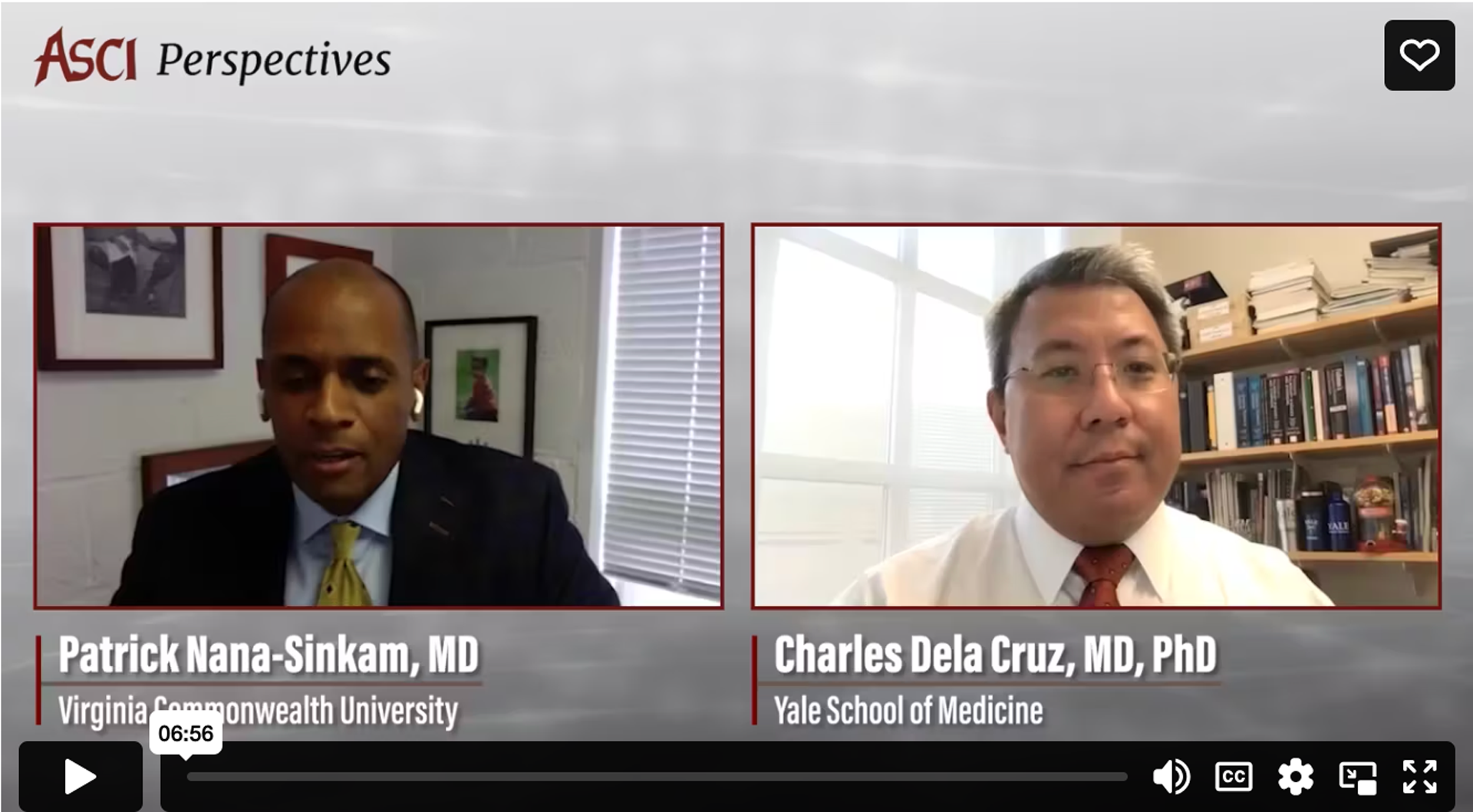
PSEC member Dr. Patrick Nana-Sinkam interviewed 2022 ASCI inductee Charles S. Dela Cruz, MD, PhD (view profile), at the end of the year. Dr. Dela Cruz is Associate Professor of Medicine (Pulmonary Critical Care and Sleep Medicine) and Microbial Pathogenesis; Director, Center for Pulmonary Infection Research and Treatment (CPIRT); Vice Chief, Clinical and Basic Research; and Director, Physician Scientist Training Program in the Department of Internal Medicine at Yale School of Medicine. His laboratory studies the role of respiratory infection in the pathogenesis of acute and chronic lung diseases, specifically how lung infection/pneumonia contribute to inflammation, injury, and tissue repair in the lung. Dr. Dela Cruz discusses his history as a researcher and clinician, offers advice about finding a niche in both areas, and reflects on how the experience with COVID is influencing how the physician-scientist works. — Posted December 2022
Maya Hoptman
Valerie A. Arboleda, MD, PhD—video clip
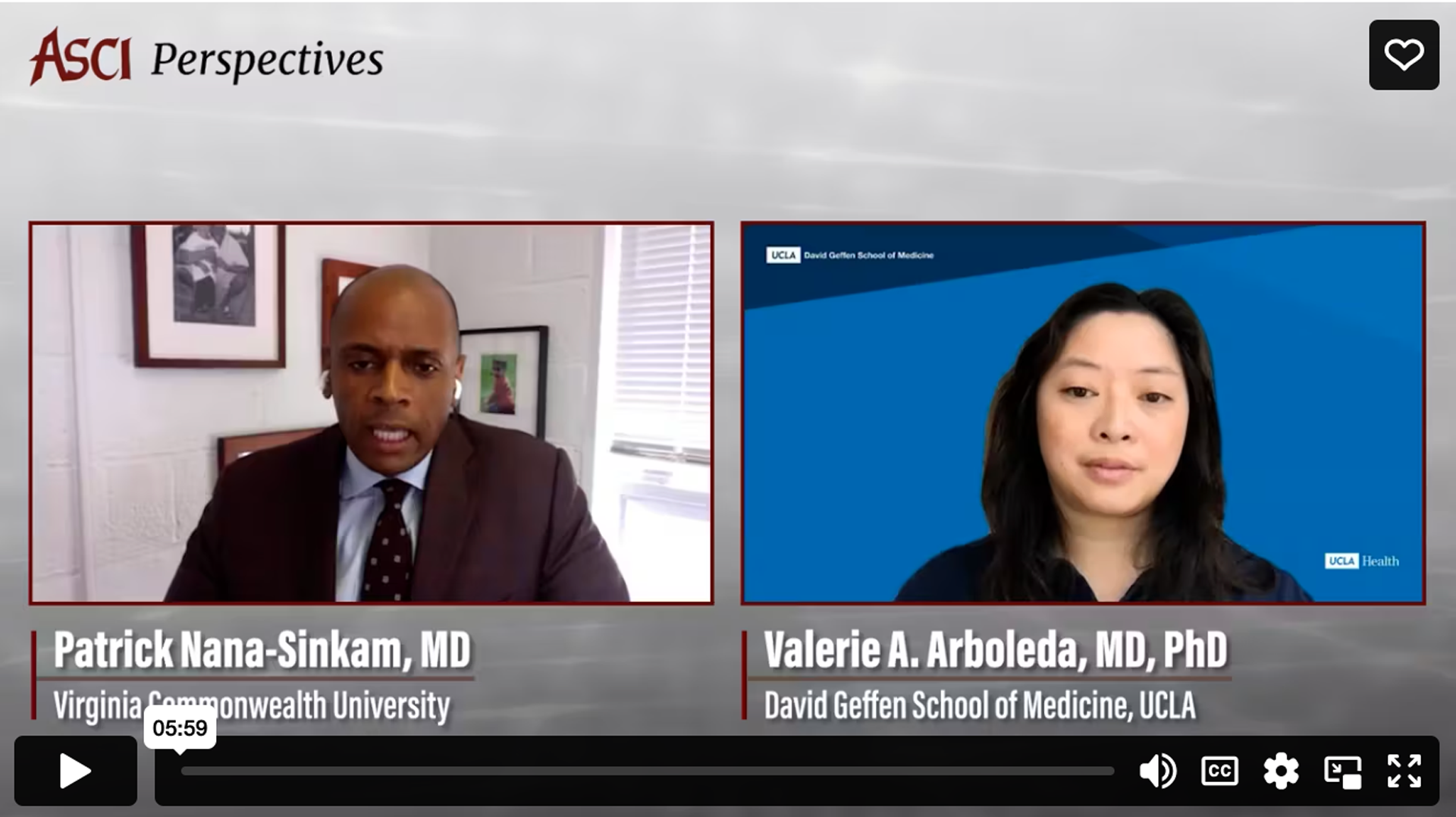
Our second Perspectives video features PSEC member Dr. Patrick Nana-Sinkam’s interview with 2022 ASCI inductee Valerie A. Arboleda, MD, PhD (view profile), Assistant Professor of Pathology, Laboratory Medicine, and Human Genetics at the University of California, Los Angeles. Dr. Arboleda’s research focuses on the application of next-generation sequencing to understand the basis of genetic syndromes. She talks about her scientific background; her contribution to developing an FDA-approved scalable COVID-19 test; and the need to improve equity in genetic testing.
Diversity, Equity, and Inclusion update — July 2022
The Diversity, Equity, and Inclusion Committee is pleased to announce a new video series, ASCI Perspectives.


Led by Committee Member Patrick Nana-Sinkam, MD (right; Virginia Commonwealth University; elected 2019), the interviews are a forum to highlight physician-scientists in the ASCI community who are members of populations underrepresented in medicine or science (UiMS). We invite you to watch for first-person insights into the guest’s career path, scientific work, and mentoring and collaborative relationships.
We are proud to initiate the series with new ASCI member Consuelo H. Wilkins, MD, MSCI (left; view profile), who is Chief Equity Officer and Senior Associate Dean for Health Equity and Inclusive Excellence; Associate Director of the Vanderbilt Institute for Translational Science; and Professor of Medicine, Division of Geriatric Medicine, Vanderbilt University. Dr. Wilkins, a leading health equity researcher, discusses the origins of her research path and shares lessons learned.
View the video: full interview (15.5 min); shorter clip (4.5 min).
Click here to read the transcript.
ASCI Resources
- Current DEIC members
- ASCI statement on diversity, inclusion, and equity
- Voters approve Diversity, Inclusion, and Equity Committee for addition to bylaws
- ASCI definitions of diversity, equity, inclusion, and underrepresented in medicine and science
Consuelo H. Wilkins, MD, MSCI—video clip
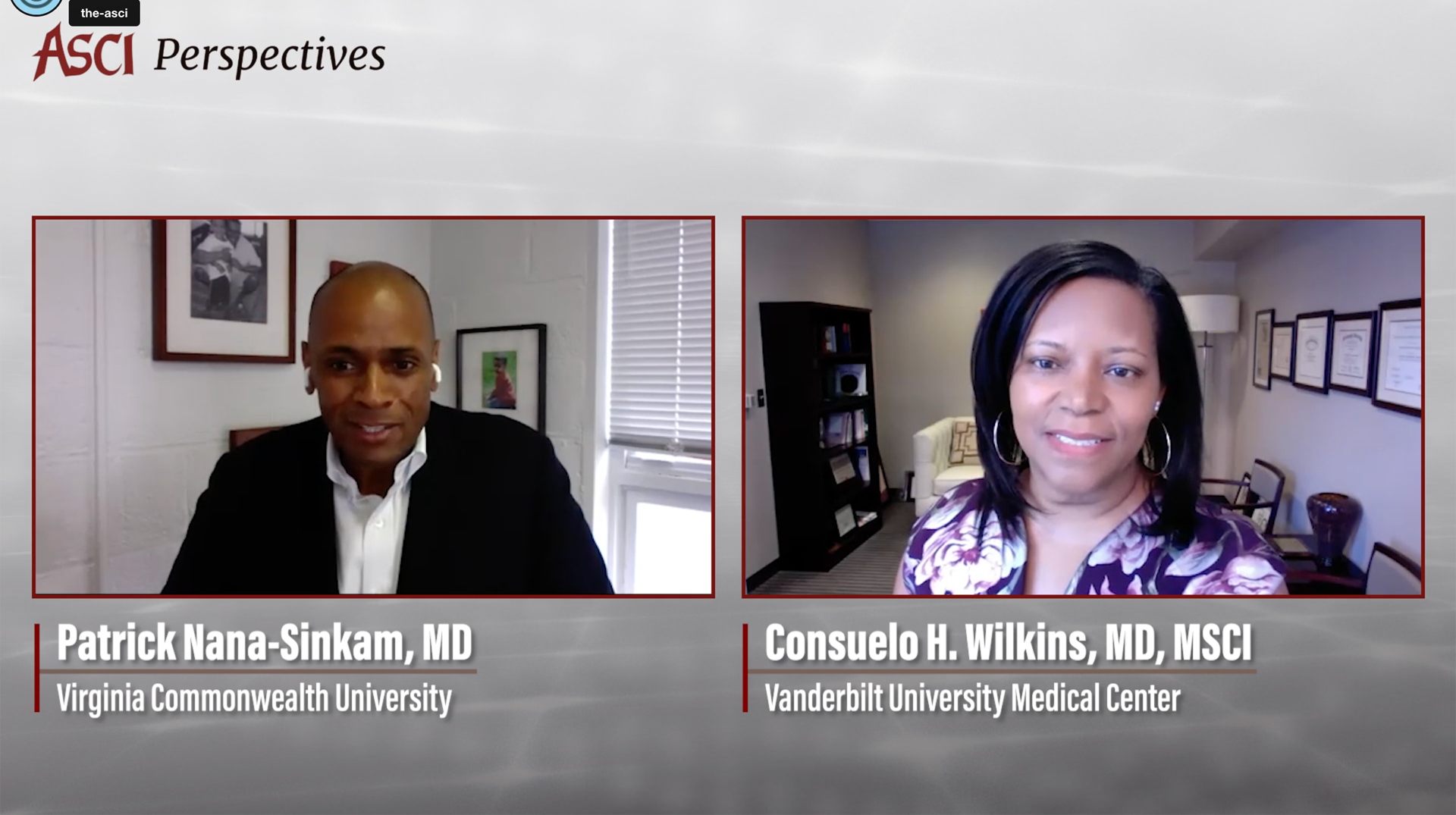
The PSEC is proud to initiate the ASCI Perspectives series with DEIC member Dr. Patrick Nana-Sinkam’s (elected 2019; view profile) interview with Consuelo H. Wilkins, MD, MSCI (elected 2022; view profile). Dr. Wilkins is Chief Equity Officer and Senior Associate Dean for Health Equity and Inclusive Excellence; Associate Director of the Vanderbilt Institute for Translational Science; and Professor of Medicine, Division of Geriatric Medicine, Vanderbilt University. She was elected to the National Academy of Medicine in 2020. In the interview, Dr. Wilkins, a leading health equity researcher, discusses the origins of her research path and shares lessons learned.
Diversity, Equity, and Inclusion update – March 2021
Message from the Chair
March 2021

I am pleased to share with you the the accomplishments of the Diversity, Equity, and Inclusion Committee (DEIC) since it was established in 2020. The ASCI bylaws state that the DEIC “ensures that the organization, its programs, and its mentoring mechanisms promote and recognize diversity, inclusion, and equity.” With these goals in mind, the Committee has developed two foundational documents.
The first intended to establish a common understanding of key terms. This Definitions document outlines the considerations underlying diversity, equity, and inclusion, as well as presenting the term “underrepresented in medicine and science (UiMS)” in reference to populations that are underrepresented relative to their numbers in the general US population.
The second is a mechanism to collect detailed demographic information, which was initiated with the 2022 member nomination process and will be applied in all areas of the Society. We ask that members provide demographic details through their ASCI account. The data will allow us to determine the current makeup of the Society’s populations, areas needing attention, and changes over time. Information will be kept confidential, and data deidentified for any reporting.
I look forward to bringing you news of further steps the Committee and the ASCI undertake in the areas of diversity, equity, and inclusion, and invite you to return to this page for periodic updates and additional resources.
Sincerely, on behalf of the Committee,
Sophie Paczesny, MD, PhD
Chair, Diversity, Equity, and Inclusion Committee
Past messages of note
- June 2020 – From the ASCI President. In view of the events of 2020 that brought US systemic racism and inequality into sharp focus, President Lorraine Ware described in a message to the membership a plan to establish a Diversity, Inclusion, and Equity Committee in the ASCI bylaws. The Committee’s would aim to ensure that all ASCI programs emphasize diversity, inclusion, and equity; establish mentoring opportunities for underrepresented physician-scientists; and consider how the ASCI can better recognize and promote health equity research.
- August 2020 – JCI Viewpoint. The leadership of the Society, the Journal of Clinical Investigation, and JCI Insight expanded on the Statement with a publication in the JCI, providing greater detail – including planned evaluation of the current status of diversity, inclusion, and equity — as well as historical and present-day context for the ASCI and its publications.
Resources
ASCI pages and posts
- Current DEIC members
- ASCI statement on diversity, inclusion, and equity
- Voters approve Diversity, Inclusion, and Equity Committee for addition to bylaws
- ASCI definitions of diversity, equity, inclusion, and underrepresented in medicine and science
Publications in the JCI Family of Journals
JCI Viewpoints
- The US biological sciences faculty gap in Asian representation
- The quagmire of race, genetic ancestry, and health disparities
- Innovations in MD-only physician-scientist training: experiences from the Burroughs Wellcome Fund physician-scientist institutional award initiative
- An immigrant’s experience: science is a discipline without borders
- Contributions of immigrants to biomedical research in the US: a personal reflection
- Getting into good trouble: Black lives matter and Black professors matter
- Promoting the success of women and minority physician-scientists in academic medicine: a dean’s perspective
- Toward realizing diversity in academic medicine
- Reflections of a Black woman physician-scientist
- A deliberate path toward diversity, equity, and inclusion within the ASCI
- COVID-19, racism, and thepursuit of health care and research worthy of trust
- Toward an equitable society: building a culture of antiracism in health care
- Controversies surrounding female athletes with differences in sexual development
- Using admission statistics to encourage diverse applicants to MD-PhD programs
- Equity and diversity in academic medicine: a perspective from the JCI editors
- The perils of intersectionality: racial and sexual harassment in medicine
- Diving beneath the surface: addressing gender inequities among clinical investigators
JCI Editorial
Presidential addresses
- 2021 ASCI: Physician-scientists in the pandemic era: tidal wave or rising tide?
- 2020 American Physician Scientist Association: “Stop scaring the children”: a call for resilient and tenacious optimism
- 2019 Association of American Physicians: Diversification in the medical sciences fuels growth of physician-scientists
JCI Insight Perspectives
JCI Editor’s update, January 2021
Dear Colleague,
As the year 2021 begins, I would like to take the opportunity to update you on recent JCI activity. The Journal continues to build on its history of publishing outstanding biomedical research that garners wide attention (highlighted below my signature).
The COVID-19 pandemic affected the JCI’s operations in many ways:
- Due to the pandemic’s disruption of research activities, the editorial board instituted new policies to streamline the review and decision processes, and to allow authors enough time to complete additional experiments requested by reviewers (see the related editorial).
- The number of research submissions increased by almost 25% in 2020 compared with 2019.
- Among a total of 424 research articles, the JCI published 19 on COVID-19.
In the Clinical Medicine (CMED) category, now in its eighth year, the JCI continues to welcome submissions reporting diagnostic advances, new medical therapies and interventions, and observational studies that have the potential to improve medical practice and health outcomes. In 2020, the JCI published 57 CMED articles, including:
- Clinical and immunological features of severe and moderate coronavirus disease 2019 (times viewed: 48,645)
- Early safety indicators of COVID-19 convalescent plasma in 5000 patients (times viewed: 8,344)
JCI Viewpoint articles have showcased experts and thought leaders in medicine, academia, nonprofit organizations, and industry, and representatives of the JCI and the ASCI on subjects of topical and long-term interest to scientists and society at large. In January, the Journal published a series of Viewpoints on the effects of climate change on human health. A July Viewpoint, Preventing cytokine storm syndrome in COVID-19 using α-1 adrenergic receptor antagonists, attracted nearly 16,000 views. Other Viewpoint articles have dealt with COVID-19; translational medicine; the effects of vaping; marijuana use in pregnancy; alternative medicine; and racism, diversity, and health equity. Watch for a Viewpoint series on team science to be published early this year.
The Journal published four Review Series, edited by members of our board:
- Big Data’s Future in Medicine
- Immunotherapy in Hematological Cancers
- Latency in Infectious Diseases
- Hypoxia-Inducible Factors in Disease Pathophysiology and Therapeutics
Individual Reviews covered a range of subjects, from COVID-19 to gene therapy to metabolism.
Reminders:
- ASCI members who are the corresponding author of a first-round submission to the JCI, and whose dues are current, may designate one submission per calendar year to be guaranteed for external peer review. For details, visit the JCI Information for Authors page.
- Authors may transfer manuscripts from the preprint server bioRxiv and medRxiv for submission to the JCI.
I wish you a happy and productive New Year, and look forward to reading your best work.
Sincerely,
Rexford S. Ahima, MD, PhD
Editor, The Journal of Clinical Investigation
Corresponding authors who are ASCI members are indicated in bold.
Top-viewed JCI articles, 2020
Source: Google Analytics, December 29, 2020
Times viewed: 172,437
Clinical and immunological features of severe and moderate coronavirus disease 2019
Clinical Medicine
Clinical Medicine
Times viewed: 48,645
Times viewed: 45,365
SARS-CoV-2: a storm is raging
Commentary
Commentary
Times viewed: 44,426
Times viewed: 15,768
Recent endemic coronavirus infection is associated with less-severe COVID-19
Concise Communication
Concise Communication
Times viewed: 14,447
Times viewed: 10,647
Times viewed: 9,887
Times viewed: 8,344
Times viewed: 7,771
Multisystem inflammatory syndrome in children and COVID-19 are distinct presentations of SARS–CoV-2
Clinical Medicine
Clinical Medicine
Times viewed: 6,962
The JCI in selected news outlets, 2020
Source: Altmetric, December 29, 2020
Mentioned in Popular Science
Clinical and immunological features of severe and moderate coronavirus disease 2019
Clinical Medicine
Clinical Medicine
Mentioned in National Geographic; by National Public Radio (NPR)
BCG vaccination history associates with decreased SARS-CoV-2 seroprevalence across a diverse cohort of healthcare workers
Clinical Medicine
Clinical Medicine
Mentioned in National Geographic, Popular Science
Mentioned by CNN
Mentioned in Psychology Today
Mentioned in the Daily Mail (United Kingdom)
Sleeping Beauty–engineered CAR T cells achieve antileukemic activity without severe toxicities
Clinical Medicine
Clinical Medicine
Mentioned in La Repubblica (Italy)
Mentioned in Scientific American, Newsweek
Social media activity: Twitter
Source: Altmetric, December 29, 2020
Clinical and immunological features of severe and moderate coronavirus disease 2019
Clinical Medicine
Clinical Medicine
Twitter mentions: 3,826
Twitter mentions: 2,643
SARS-CoV-2: a storm is raging
Commentary
Commentary
Twitter mentions: 2,564
Recent endemic coronavirus infection is associated with less-severe COVID-19
Concise Communication
Concise Communication
Twitter mentions: 1,088
Metabolic effects of air pollution exposure and reversibility
Concise Communication
Concise Communication
Twitter mentions: 569
Twitter mentions: 464
COVID-19 survival associates with the immunoglobulin response to the SARS-CoV-2 spike receptor binding domain
Clinical Medicine
Clinical Medicine
Twitter mentions: 349
Articles with ASCI members as corresponding authors in 2020
Decreased sphingolipid synthesis in children with 17q21 asthma–risk genotypes
Concise Communication
Concise Communication
Staphylococcus aureus toxin suppresses antigen-specific T cell responses
Concise Communication
Concise Communication
Dominant mutations of the Notch ligand Jagged1 cause peripheral neuropathy
Concise Communication
Concise Communication
Gut microbiome communication with bone marrow regulates susceptibility to amebiasis
Concise Communication
Concise Communication
Mapping mania symptoms based on focal brain damage
Clinical Medicine
Clinical Medicine
Metabolic effects of air pollution exposure and reversibility
Concise Communication
Concise Communication
JCI Editor’s update, December 2019
Dear Colleague,
As the year draws to a close, I wanted to take the opportunity to update you on recent JCI activity. The Journal continues to build on its history of publishing outstanding biomedical research, garnering wide attention in the scientific literature, the press, and social media (highlighted below). In particular, the Clinical Medicine category, now in its seventh year, continues to flourish, with 25 articles published in 2019. Among these were two of the highest-cited JCI papers of the year, on the role of androgen receptor splice variant-7 in castration-resistant prostate cancer; and the use of B cell maturation antigen–targeted CAR T cells in multiple myeloma. We welcome submissions from ASCI members reporting new medical therapies, interventions, diagnostic advances, or observational studies in humans that have the potential to change medical practice.
Viewpoint articles have given voice to experts and thought leaders in medicine, academia, nonprofit organizations, industry, and representatives of the JCI and ASCI on subjects of topical and long-term interest. In one recent Viewpoint (available here), the women on the JCI Editorial Board share their perspective on achieving equity for women and underrepresented minorities in academic medicine leadership, including in societies and journals. In another, Kieren Marr (2018-19 ASCI President) et al. discuss the Society’s strategic support of physician-scientists. In early January, look for a series of Viewpoints on the effects of climate change on human health.
The Journal published four Review Series this year, on mechanisms underlying the metabolic syndrome, reparative immunology, allergy, and familial cancer predisposition syndromes, the latter three with series editors who are ASCI members. Individual Reviews covered a range of subjects, from vaccines to endocrinology to neurology, including a highly cited article on the functional significance of platelet immune receptors.
Reminders:
- ASCI members who are the corresponding author of a first-round submission to the JCI, and whose dues are current, may designate one submission per calendar year to be guaranteed for external peer review. For details, visit the For Authors page.
- Authors may transfer manuscripts from the preprint server bioRxiv for submission to the JCI.
I wish you all the best for the New Year, and look forward to reading your best work.
Sincerely,
Rexford S. Ahima, MD, PhD
Editor, The Journal of Clinical Investigation
The JCI in selected news outlets, 2019
Source: Altmetric. Corresponding authors who are ASCI members are indicated in bold.
Enhancing glycolysis attenuates Parkinson’s disease progression in models and clinical databases
Research
Research
Mentioned in BBC News
Electronic cigarettes disrupt lung lipid homeostasis and innate immunity independent of nicotine
Research
Research
Mentioned in Japan Times; Haaretz (Israel); US News and World Report; WIRED
Mentioned in Newsweek
Identifying and targeting pathogenic PI3K/AKT/mTOR signaling in IL-6 blockade–refractory idiopathic multicentric Castleman disease
Clinical Medicine
Clinical Medicine
Mentioned in Newsweek
Cingulum stimulation enhances positive affect and anxiolysis to facilitate awake craniotomy
Clinical Medicine
Clinical Medicine
Mentioned in Discover Magazine and Der Spiegel
Gut-derived GIP activates central Rap1 to impair neural leptin sensitivity during overnutrition
Concise Communication
Concise Communication
Mentioned in Wiener-Zeitung (Austria); Daily Mail (United Kingdom)
Social media activity: Twitter
Source: Altmetric, November 2019. Corresponding authors who are ASCI members are indicated in bold.
Twitter mentions: 395
Preoperative stimulation of resolution and inflammation blockade eradicates micrometastases
Research
Research
Twitter mentions: 322
Elevation of plasma tRNA fragments precedes seizures in human epilepsy
Concise Communication
Concise Communication
Twitter mentions: 218
Highest-cited research published in 2019
Source: Web of Science as of November 25, 2019. Corresponding authors who are ASCI members are indicated in bold.
Androgen receptor splice variant-7 expression emerges with castration resistance in prostate cancer
Clinical Medicine
Clinical Medicine
Times cited: 23
Times cited: 22
PARP inhibition enhances tumor cell–intrinsic immunity in ERCC1-deficient non–small cell lung cancer
Research
Research
Times cited: 14
B cell maturation antigen-specific CAR T cells are clinically active in multiple myeloma
Clinical Medicine
Clinical Medicine
Times cited: 13
Times cited: 12
Times cited: 12
Times cited: 12
Times cited: 10
JCI research with ASCI members as corresponding authors, 2019
JCI Insight Editor’s Update, December 2019
Dear Colleague,
I am pleased to be sending you this first update as Editor of JCI Insight. Along with Deputy Editors Andrew Lieberman, Donna Martin, and Pavan Reddy, we have seamlessly transitioned the journal to a new Editorial Board. The Board represents the breadth of expertise that is a hallmark of the ASCI membership and meets in person weekly to discuss manuscripts under consideration. JCI Insight continues to publish translational and early-phase clinical studies in all disciplines of biomedical research, and many have attracted considerable attention in the academic and lay press, as well as social media (see below). In particular, the Journal published 39 Clinical Medicine articles in 2019, in areas such as infectious disease, immunology, cardiology, metabolism, neuroscience, dermatology, and otology.
This year, we initiated the JCI Insight Scholars program, in which Board members provide mentorship and training in academic peer review and editorship to young physician-scientists. Andrea D. Thompson, a cardiology fellow at the University of Michigan, is the first to hold this position; the next cohort of Scholars will begin in February 2020. Also focusing on the physician-scientist experience, the journal recently published two Perspective articles on the national MD-PhD program outcomes study.
A few reminders:
- Authors can transfer their bioRxiv manuscripts for consideration by JCI Insight.
- Insight offers authors the opportunity to publish accepted submissions as In-Press Previews.
- Authors can provide graphical abstracts as well as video overviews of their work to accompany their published articles.
- Any dues-paying ASCI member who is a corresponding author of a first-round submission to JCI Insight, and whose dues are current, may designate up to three submissions per calendar year to be guaranteed for external peer review.
We look forward to the New Year and the opportunities it brings for reviewing our first several months on the job and developing new initiatives. We welcome any input and suggestions, and encourage you to consider JCI Insight as a venue for your work.
Sincerely,
Kathleen L. Collins, MD, PhD
Editor, JCI Insight
Social media activity: Twitter
Source: Altmetric, November 2019.
Dietary carbohydrate restriction improves metabolic syndrome independent of weight loss
Clinical Medicine
Clinical Medicine
Twitter mentions: 736
Twitter mentions: 236
Twitter mentions: 122
Twitter mentions: 119
JCI Insight in selected news outlets
Source: Altmetric. Corresponding authors who are ASCI members are indicated in bold.
Mentioned in CNN Health, Detroit Free Press
Mentioned in Newsweek
Dietary carbohydrate restriction improves metabolic syndrome independent of weight loss
Clinical Medicine
Clinical Medicine
Mentioned in Vox.com
Highest-cited research published in 2019
Source: Web of Science as of December 5, 2019. Corresponding authors who are ASCI members are indicated in bold.
PD-L1 expression and tumor mutational burden are independent biomarkers in most cancers
Clinical Medicine
Clinical Medicine
Times cited: 11
Times cited: 11
Times cited: 9
Effect of ivacaftor on mucociliary clearance and clinical outcomes in cystic fibrosis patients with G551D-CFTR
Clinical Medicine
Clinical Medicine
Times cited: 8
Times cited: 7
Times cited: 7
Platelet-targeted dual pathway antithrombotic inhibits thrombosis with preserved hemostasis
Research
Research
Times cited: 7
JCI Insight research with ASCI members as corresponding authors, 2019
JCI Editor’s update: Plan S, JCI Scholars, recent reviews, and more
Dear Colleague,
I’d like to take this opportunity to remind you of the JCI’s longstanding commitment to making all research articles available free of charge. The ASCI adopted this model in 1996 when the journal first went online, and all of our research content, from 1924 to the present, is publicly available. As ever more journals have created open access options, both researchers and funders have become involved in the conversation about publishing models and disseminating journal content. A coalition of European funders recently proposed requirements that research articles funded by their organizations be published in open access publications (see Free access to scientific publications: contrasting the JCI approach to Plan S). While details of Plan S are still emerging, I want to reaffirm the JCI’s continued support for free access for all to scientific research, a tradition that is also carried on in JCI Insight.
I would also like to highlight the JCI Scholars program, an initiative started by the current editorial board when our tenure began in 2017. The program provides physician-scientist trainees a unique opportunity to participate in manuscript evaluation and better understand the peer review and publishing process. We’ve recently expanded the program to include medical fellows as well as MD/PhD students from Johns Hopkins and the University of Maryland, and we have 8 new trainees participating in 2019. A Viewpoint article written by JCI Scholars who recently completed the program shares insights gained during their time shadowing the Editorial Board. I hope that their perspective might be useful to other young scientists in your lab as well. Read their article, as well as others in our Viewpoint series.
Sincerely,
Rexford S. Ahima, MD, PhD
Editor, The Journal of Clinical Investigation
Features for authors
- Authors can transfer their bioRxiv manuscripts for consideration by the JCI.
- The JCI offers authors the opportunity to publish accepted submissions as In-Press Previews.
- Authors can provide graphical abstracts as well as video overviews of their work to accompany their published articles.
- ASCI member guaranteed review: ASCI members who are the corresponding author of a first-round submission to JCI and whose dues are current may designate one submission per calendar year to be guaranteed for external peer review.
Recent Review Series
ASCI members are indicated in bold.
Biology of familial cancer predisposition syndromes
Series edited by Mary Armanios and Agata Smogorzewska
Hypoxia, angiogenesis, and metabolism in the hereditary kidney cancers
John C. Chappell, Laura Beth Payne, and W. Kimryn Rathmell
PTEN-opathies: from biological insights to evidence-based precision medicine
Lamis Yehia, Joanne Ngeow, and Charis Eng
Misactivation of Hedgehog signaling causes inherited and sporadic cancers
David R. Raleigh and Jeremy F. Reiter
Transcription factor mutations as a cause of familial myeloid neoplasms
Jane E. Churpek and Emery H. Bresnick
Recently published Reviews
Corresponding authors who are ASCI members are indicated in bold.
Mitochondria, OxPhos, and neurodegeneration: cells are not just running out of gas
Estela Area-Gomez, Cristina Guardia-Laguarta, Eric A. Schon, and Serge Przedborski
Molecular imaging of fibrosis: recent advances and future directions
Sydney B. Montesi, Pauline Désogère, Bryan C. Fuchs, and Peter Caravan
Mixing old and young: enhancing rejuvenation and accelerating aging
Ashley Lau, Brian K. Kennedy, James L. Kirkland, and Stefan G. Tullius
Functional significance of the platelet immune receptors GPVI and CLEC-2
Julie Rayes, Steve P. Watson, and Bernhard Nieswandt
Selective tissue targeting of synthetic nucleic acid drugs
Punit P. Seth, Michael Tanowitz, and C. Frank Bennett
Autoimmune seizures and epilepsy
Christian Geis, Jesus Planagumà, Mar Carreño, Francesc Graus, and Josep Dalmau
Environmental exposures and mechanisms in allergy and asthma development
Liza Bronner Murrison, Eric B. Brandt, Jocelyn Biagini Myers, and Gurjit K. Khurana Hershey
Epithelial barrier repair and prevention of allergy
Elena Goleva, Evgeny Berdyshev, and Donald Y.M. Leung
Top-cited JCI research articles
Data from Scopus, February 25, 2019. Corresponding authors who are ASCI members are indicated in bold.
Host expression of PD-L1 determines efficacy of PD-L1 pathway blockade–mediated tumor regression
Heng Lin, Shuang Wei, Elaine M. Hurt, Michael D. Green, Lili Zhao, Linda Vatan, Wojciech Szeliga, Ronald Herbst, Paul W. Harms, Leslie A. Fecher, Pankaj Vats, Arul M. Chinnaiyan, Christopher D. Lao, Theodore S. Lawrence, Max Wicha, Junzo Hamanishi, Masaki Mandai, Ilona Kryczek, and Weiping Zou
Times cited: 28
PD-L1 on host cells is essential for PD-L1 blockade–mediated tumor regression
Haidong Tang, Yong Liang, Robert A. Anders, Janis M. Taube, Xiangyan Qiu, Aditi Mulgaonkar, Xin Liu, Susan M. Harrington, Jingya Guo, Yangchun Xin, Yahong Xiong, Kien Nham, William Silvers, Guiyang Hao, Xiankai Sun, Mingyi Chen, Raquibul Hannan, Jian Qiao, Haidong Dong, Hua Peng, and Yang-Xin Fu
Times cited: 25
Mucus plugs in patients with asthma linked to eosinophilia and airflow obstruction
Eleanor M. Dunican, Brett M. Elicker, David S. Gierada, Scott K. Nagle, Mark L. Schiebler, John D. Newell, Wilfred W. Raymond, Marrah E. Lachowicz-Scroggins, Selena Di Maio, Eric A. Hoffman, Mario Castro, Sean B. Fain, Nizar N. Jarjour, Elliot Israel, Bruce D. Levy, Serpil C. Erzurum, Sally E. Wenzel, Deborah A. Meyers, Eugene R. Bleecker, Brenda R. Phillips, David T. Mauger, Erin D. Gordon, Prescott G. Woodruff, Michael C. Peters, John V. Fahy, and The National Heart Lung and Blood Institute (NHLBI) Severe Asthma Research Program (SARP)
Times cited: 22
Early B cell changes predict autoimmunity following combination immune checkpoint blockade
Rituparna Das, Noffar Bar, Michelle Ferreira, Aaron M. Newman, Lin Zhang, Jithendra Kini Bailur, Antonella Bacchiocchi, Harriet Kluger, Wei Wei, Ruth Halaban, Mario Sznol, Madhav V. Dhodapkar, and Kavita M. Dhodapkar
Times cited: 19
Latent HIV reservoirs exhibit inherent resistance to elimination by CD8+ T cells
Szu-Han Huang, Yanqin Ren, Allison S. Thomas, Dora Chan, Stefanie Mueller, Adam R. Ward, Shabnum Patel, Catherine M. Bollard, Conrad Russell Cruz, Sara Karandish, Ronald Truong, Amanda B. Macedo, Alberto Bosque, Colin Kovacs, Erika Benko, Alicja Piechocka-Trocha, Hing Wong, Emily Jeng, Douglas F. Nixon, Ya-Chi Ho, Robert F. Siliciano, Bruce D. Walker, and R. Brad Jones
Times cited: 18
Hepatitis B virus–specific T cells associate with viral control upon nucleos(t)ide-analogue therapy discontinuation
Laura Rivino, Nina Le Bert, Upkar S. Gill, Kamini Kunasegaran, Yang Cheng, Damien Z.M. Tan, Etienne Becht, Navjyot K. Hansi, Graham R. Foster, Tung-Hung Su, Tai-Chung Tseng, Seng Gee Lim, Jia-Horng Kao, Evan W. Newell, Patrick T.F. Kennedy, and Antonio Bertoletti
Times cited: 17
JAK1/2 inhibition with baricitinib in the treatment of autoinflammatory interferonopathies
Gina A. Montealegre Sanchez, Adam Reinhardt, Suzanne Ramsey, Helmut Wittkowski, Philip J. Hashkes, Yackov Berkun, Susanne Schalm, Sara Murias, Jason A. Dare, Diane Brown, Deborah L. Stone, Ling Gao, Thomas Klausmeier, Dirk Foell, Adriana A. de Jesus, Dawn C. Chapelle, Hanna Kim, Samantha Dill, Robert A. Colbert, Laura Failla, Bahar Kost, Michelle O’Brien, James C. Reynolds, Les R. Folio, Katherine R. Calvo, Scott M. Paul, Nargues Weir, Alessandra Brofferio, Ariane Soldatos, Angelique Biancotto, Edward W. Cowen, John J. Digiovanna, Massimo Gadina, Andrew J. Lipton, Colleen Hadigan, Steven M. Holland, Joseph Fontana, Ahmad S. Alawad, Rebecca J. Brown, Kristina I. Rother, Theo Heller, Kristina M. Brooks, Parag Kumar, Stephen R. Brooks, Meryl Waldman, Harsharan K. Singh, Volker Nickeleit, Maria Silk, Apurva Prakash, Jonathan M. Janes, Seza Ozen, Paul G. Wakim, Paul A. Brogan, William L. Macias, and Raphaela Goldbach-Mansky
Times cited: 15
Influenza-specific lung-resident memory T cells are proliferative and polyfunctional and maintain diverse TCR profiles
Angela Pizzolla, Thi H.O. Nguyen, Sneha Sant, Jade Jaffar, Tom Loudovaris, Stuart I. Mannering, Paul G. Thomas, Glen P. Westall, Katherine Kedzierska, and Linda M. Wakim
Times cited: 15
Insulin resistance causes inflammation in adipose tissue
Mitsugu Shimobayashi, Verena Albert, Bettina Woelnerhanssen, Irina C. Frei, Diana Weissenberger, Anne Christin Meyer-Gerspach, Nicolas Clement, Suzette Moes, Marco Colombi, Jerome A. Meier, Marta M. Swierczynska, Paul Jenö, Christoph Beglinger, Ralph Peterli, and Michael N. Hall
Times cited: 14
Specialized fibroblast differentiated states underlie scar formation in the infarcted mouse heart
Xing Fu, Hadi Khalil, Onur Kanisicak, Justin G. Boyer, Ronald J. Vagnozzi, Bryan D. Maliken, Michelle A. Sargent, Vikram Prasad, Iñigo Valiente-Alandi, Burns C. Blaxall, and Jeffery D. Molkentin
Times cited: 13
CD163+ macrophages promote angiogenesis and vascular permeability accompanied by inflammation in atherosclerosis
Liang Guo, Hirokuni Akahori, Emanuel Harari, Samantha L. Smith, Rohini Polavarapu, Vinit Karmali, Fumiyuki Otsuka, Rachel L. Gannon, Ryan E. Braumann, Megan H. Dickinson, Anuj Gupta, Audrey L. Jenkins, Michael J. Lipinski, Johoon Kim, Peter Chhour, Paul S. de Vries, Hiroyuki Jinnouchi, Robert Kutys, Hiroyoshi Mori, Matthew D. Kutyna, Sho Torii, Atsushi Sakamoto, Cheol Ung Choi, Qi Cheng, Megan L. Grove, Mariem A. Sawan, Yin Zhang, Yihai Cao, Frank D. Kolodgie, David P. Cormode, Dan E. Arking, Eric Boerwinkle, Alanna C. Morrison, Jeanette Erdmann, Nona Sotoodehnia, Renu Virmani, and Aloke V. Finn
Times cited: 13
Recent articles with ASCI members as corresponding authors
Neutrophil extracellular trap production contributes to pathogenesis in SIV-infected nonhuman primates
Ranjit Sivanandham, Egidio Brocca-Cofano, Noah Krampe, Elizabeth Falwell, Sindhuja Murali Kilapandal Venkatraman, Ruy M. Ribeiro, Cristian Apetrei, and Ivona Pandrea
Kidney-infiltrating T cells in murine lupus nephritis are metabolically and functionally exhausted
Jeremy S. Tilstra, Lyndsay Avery, Ashley V. Menk, Rachael A. Gordon, Shuchi Smita, Lawrence P. Kane, Maria Chikina, Greg M. Delgoffe, and Mark J. Shlomchik
The two-pore domain potassium channel TREK-1 mediates cardiac fibrosis and diastolic dysfunction
Dennis M. Abraham, Teresa E. Lee, Lewis J. Watson, Lan Mao, Gurangad Chandok, Hong-Gang Wang, Stephan Frangakis, Geoffrey S. Pitt, Svati H. Shah, Matthew J. Wolf, and Howard A. Rockman
Super-enhancers maintain renin-expressing cell identity and memory to preserve multi-system homeostasis
Maria Florencia Martinez, Silvia Medrano, Evan A. Brown, Turan Tufan, Stephen Shang, Nadia Bertoncello, Omar Guessoum, Mazhar Adli, Brian C. Belyea, Maria Luisa S. Sequeira-Lopez, and R. Ariel Gomez
Interaction between smoking and ATG16L1T300A triggers Paneth cell defects in Crohn’s disease
Ta-Chiang Liu, Justin T. Kern, Kelli L. VanDussen, Shanshan Xiong, Gerard E. Kaiko, Craig B. Wilen, Michael W. Rajala, Roberta Caruso, Michael J. Holtzman, Feng Gao, Dermot P.B. McGovern, Gabriel Nunez, Richard D. Head, and Thaddeus S. Stappenbeck
SMAD4 promotes TGF-β–independent NK cell homeostasis and maturation and antitumor immunity
Youwei Wang, Jianhong Chu, Ping Yi, Wejuan Dong, Jennifer Saultz, Yufeng Wang, Hongwei Wang, Steven Scoville, Jianying Zhang, Lai-Chu Wu, Youcai Deng, Xiaoming He, Bethany Mundy-Bosse, Aharon G. Freud, Li-Shu Wang, Michael A. Caligiuri, and Jianhua Yu
Loss of placental growth factor ameliorates maternal hypertension and preeclampsia in mice
Jacqueline G. Parchem, Keizo Kanasaki, Megumi Kanasaki, Hikaru Sugimoto, Liang Xie, Yuki Hamano, Soo Bong Lee, Vincent H. Gattone, Samuel Parry, Jerome F. Strauss, Vesna D. Garovic, Thomas F. McElrath, Karen H. Lu, Baha M. Sibai, Valerie S. LeBleu, Peter Carmeliet, and Raghu Kalluri
Survival signal REG3α prevents crypt apoptosis to control acute gastrointestinal graft-versus-host disease
Dongchang Zhao, Yeung-Hyen Kim, Seihwan Jeong, Joel K. Greenson, Mohammed S. Chaudhry, Matthias Hoepting, Erik R. Anderson, Marcel R.M. van den Brink, Jonathan U. Peled, Antonio L.C. Gomes, Ann E. Slingerland, Michael J. Donovan, Andrew C. Harris, John E. Levine, Umut Ozbek, Lora V. Hooper, Thaddeus S. Stappenbeck, Aaron Ver Heul, Ta-Chiang Liu, Pavan Reddy, and James L.M. Ferrara
Antisense STAT3 inhibitor decreases viability of myelodysplastic and leukemic stem cells
Aditi Shastri, Gaurav Choudhary, Margarida Teixeira, Shanisha Gordon-Mitchell, Nandini Ramachandra, Lumie Bernard, Sanchari Bhattacharyya, Robert Lopez, Kith Pradhan, Orsolya Giricz, Goutham Ravipati, Li-Fan Wong, Sally Cole, Tushar D. Bhagat, Jonathan Feld, Yosman Dhar, Matthias Bartenstein, Victor J. Thiruthuvanathan, Amittha Wickrema, B. Hilda Ye, David A. Frank, Andrea Pellagatti, Jacqueline Boultwood, Tianyuan Zhou, Youngsoo Kim, A. Robert MacLeod, P.K. Epling-Burnette, Minwei Ye, Patricia McCoon, Richard Woessner, Ulrich Steidl, Britta Will, and Amit Verma
Temporal dynamics of Wnt-dependent transcriptome reveal an oncogenic Wnt/MYC/ribosome axis
Babita Madan, Nathan Harmston, Gahyathiri Nallan, Alex Montoya, Peter Faull, Enrico Petretto, and David M. Virshup
PI3K p110δ inactivation antagonizes chronic lymphocytic leukemia and reverses T cell immune suppression
Shuai Dong, Bonnie K. Harrington, Eileen Y. Hu, Joseph T. Greene, Amy M. Lehman, Minh Tran, Ronni L. Wasmuth, Meixiao Long, Natarajan Muthusamy, Jennifer R. Brown, Amy J. Johnson, and John C. Byrd
An airway epithelial IL-17A response signature identifies a steroid-unresponsive COPD patient subgroup
Stephanie A. Christenson, Maarten van den Berge, Alen Faiz, Kai Inkamp, Nirav Bhakta, Luke R. Bonser, Lorna T. Zlock, Igor Z. Barjaktarevic, R. Graham Barr, Eugene R. Bleecker, Richard C. Boucher, Russell P. Bowler, Alejandro P. Comellas, Jeffrey L. Curtis, MeiLan K. Han, Nadia N. Hansel, Pieter S. Hiemstra, Robert J. Kaner, Jerry A. Krishnanm, Fernando J. Martinez, Wanda K. O’Neal, Robert Paine III, Wim Timens, J. Michael Wells, Avrum Spira, David J. Erle, and Prescott G. Woodruff
Type 2 deiodinase polymorphism causes ER stress and hypothyroidism in the brain
Sungro Jo, Tatiana L. Fonseca, Barbara M.L.C. Bocco, Gustavo W. Fernandes, Elizabeth A. McAninch, Anaysa P. Bolin, Rodrigo R. Da Conceição, Joao Pedro Werneck-de-Castro, Daniele L. Ignacio, Péter Egri, Dorottya Németh, Csaba Fekete,Maria Martha Bernardi, Victoria D. Leitch, Naila S. Mannan, Katharine F. Curry, Natalie C. Butterfield, J.H. Duncan Bassett, Graham R. Williams, Balázs Gereben, Miriam O. Ribeiro, and Antonio C. Bianco
Osteopontin mediates glioblastoma-associated macrophage infiltration and is a potential therapeutic target
Jun Wei, Anantha Marisetty, Brett Schrand, Konrad Gabrusiewicz, Yuuri Hashimoto, Martina Ott, Zacharia Grami, Ling-Yuan Kong, Xiaoyang Ling, Hillary Caruso, Shouhao Zhou, Y. Alan Wang, Gregory N. Fuller, Jason Huse, Eli Gilboa, Nannan Kang, Xingxu Huang, Roel Verhaak, Shulin Li, and Amy B. Heimberger
Tumor-conditional anti-CTLA4 uncouples antitumor efficacy from immunotherapy-related toxicity
Chien-Chun Steven Pai, Donald M. Simons, Xiaoqing Lu, Michael Evans, Junnian Wei, Yung-hua Wang, Mingyi Chen, John Huang, Chanhyuk Park, Anthony Chang, Jiaxi Wang, Susan Westmoreland, Christine Beam, Dave Banach, Diana Bowley, Feng Dong, Jane Seagal, Wendy Ritacco, Paul L. Richardson, Soumya Mitra, Grace Lynch, Pete Bousquet, John Mankovich, Gillian Kingsbury, and Lawrence Fong
Compound haploinsufficiency of Dok2 and Dusp4 promotes lung tumorigenesis
Ming Chen, Jiangwen Zhang, Alice H. Berger, Moussa S. Diolombi, Christopher Ng, Jacqueline Fung, Roderick T. Bronson, Mireia Castillo-Martin, Tin Htwe Thin, Carlos Cordon-Cardo, Robin Plevin, and Pier Paolo Pandolfi
ʟ-Carnitine in omnivorous diets induces an atherogenic gut microbial pathway in humans
Robert A. Koeth, Betzabe Rachel Lam-Galvez, Jennifer Kirsop, Zeneng Wang, Bruce S. Levison, Xiaodong Gu, Matthew F. Copeland, David Bartlett, David B. Cody, Hong J. Dai, Miranda K. Culley, Xinmin S. Li, Xiaoming Fu, Yuping Wu, Lin Li, Joseph A. DiDonato, W.H. Wilson Tang, Jose Carlos Garcia-Garcia, and Stanley L. Hazen
An alternative mitophagy pathway mediated by Rab9 protects the heart against ischemia
Toshiro Saito, Jihoon Nah, Shin-ichi Oka, Risa Mukai, Yoshiya Monden, Yasuhiro Maejima, Yoshiyuki Ikeda, Sebastiano Sciarretta, Tong Liu, Hong Li, Erdene Baljinnyam, Diego Fraidenraich, Luke Fritzky, Peiyong Zhai, Shizuko Ichinose, Mitsuaki Isobe, Chiao-Po Hsu, Mondira Kundu, and Junichi Sadoshima
Cardiac CaV1.2 channels require β subunits for β-adrenergic–mediated modulation but not trafficking
Lin Yang, Alexander Katchman, Jared Kushner, Alexander Kushnir, Sergey I. Zakharov, Bi-xing Chen, Zunaira Shuja, Prakash Subramanyam, Guoxia Liu, Arianne Papa, Daniel Roybal, Geoffrey S. Pitt, Henry M. Colecraft, and Steven O. Marx
Rescue of recurrent deep intronic mutation underlying cell type–dependent quantitative NEMO deficiency
Bertrand Boisson, Yoshitaka Honda, Masahiko Ajiro, Jacinta Bustamante, Matthieu Bendavid, Andrew R. Gennery, Yuri Kawasaki, Jose Ichishima, Mitsujiro Osawa, Hiroshi Nihira, Takeshi Shiba, Takayuki Tanaka, Maya Chrabieh, Benedetta Bigio, Hong Hur, Yuval Itan, Yupu Liang, Satoshi Okada, Kazushi Izawa, Ryuta Nishikomori, Osamu Ohara, Toshio Heike, Laurent Abel, Anne Puel, Megumu K. Saito, Jean-Laurent Casanova, Masatoshi Hagiwara, and Takahiro Yasumi
In vivo hematopoietic stem cell gene therapy ameliorates murine thalassemia intermedia
Hongjie Wang, Aphrodite Georgakopoulou, Nikoletta Psatha, Chang Li, Chrysi Capsali, Himanshu Bhusan Samal, Achilles Anagnostopoulos, Anja Ehrhardt, Zsuzsanna Izsvák, Thalia Papayannopoulou, Evangelia Yannaki, and André Lieber
Gene fitness landscape of group A streptococcus during necrotizing myositis
Luchang Zhu, Randall J. Olsen, Stephen B. Beres, Jesus M. Eraso, Matthew Ojeda Saavedra, Samantha L. Kubiak, Concepcion C. Cantu, Leslie Jenkins, Amelia R. L. Charbonneau, Andrew S. Waller, and James M. Musser
HSP90 inhibitor geldanamycin reverts IL-13– and IL-17–induced airway goblet cell metaplasia
Alejandro A. Pezzulo, Rosarie A. Tudas, Carley G. Stewart, Luis G. Vargas Buonfiglio, Brian D. Lindsay, Peter J. Taft, Nicholas D. Gansemer, and Joseph Zabner
Single-dose radiotherapy disables tumor cell homologous recombination via ischemia/reperfusion injury
Sahra Bodo, Cécile Campagne, Tin Htwe Thin, Daniel S. Higginson, H. Alberto Vargas, Guoqiang Hua, John D. Fuller, Ellen Ackerstaff, James Russell, Zhigang Zhang, Stefan Klingler, HyungJoon Cho, Matthew G. Kaag, Yousef Mazaheri, Andreas Rimner, Katia Manova-Todorova, Boris Epel, Joan Zatcky, Cristian R. Cleary, Shyam S. Rao, Yoshiya Yamada, Michael J. Zelefsky, Howard J. Halpern, Jason A. Koutcher, Carlos Cordon-Cardo, Carlo Greco, Adriana Haimovitz-Friedman, Evis Sala, Simon N. Powell, Richard Kolesnick, and Zvi Fuks
Bronchus-associated lymphoid tissue–resident Foxp3+ T lymphocytes prevent antibody-mediated lung rejection
Wenjun Li, Jason M. Gauthier, Ryuji Higashikubo, Hsi-Min Hsiao, Satona Tanaka, Linh Vuong, Jon H. Ritter, Alice Y. Tong, Brian W. Wong, Ramsey R. Hachem, Varun Puri, Ankit Bharat, Alexander S. Krupnick, Chyi S. Hsieh, William M. Baldwin III, Francine L. Kelly, Scott M. Palmer, Andrew E. Gelman, and Daniel Kreisel
Graft-versus-host disease propagation depends on increased intestinal epithelial tight junction permeability
Sam C. Nalle, Li Zuo, Ma. Lora Drizella M. Ong, Gurminder Singh, Alicia M. Worthylake, Wangsun Choi, Mario Cabrero Manresa, Anna P. Southworth, Karen L. Edelblum, Gregory J. Baker, Nora E. Joseph, Peter A. Savage, and Jerrold R. Turner
Lineage-specific events underlie aortic root aneurysm pathogenesis in Loeys-Dietz syndrome
Elena Gallo MacFarlane, Sarah J. Parker, Joseph Y. Shin, Benjamin E. Kang, Shira G. Ziegler, Tyler J. Creamer, Rustam Bagirzadeh, Djahida Bedja, Yichun Chen, Juan F. Calderon, Katherine Weissler, Pamela A. Frischmeyer-Guerrerio, Mark E. Lindsay, Jennifer P. Habashi, and Harry C. Dietz
JCI Insight Editor’s update: January 2018
I am pleased to update you on recent JCI Insight activity. Together, our outstanding Editorial Board and distinguished team of Consulting Editors have helped JCI Insight publish excellent science across all areas of biomedicine, quickly and efficiently.
As authors, ASCI members have been a driving force behind the success of the journal since its launch in January 2016 (see below for a list of recent research articles with members as corresponding authors). I encourage you to consider submitting your research to JCI Insight. A reminder: ASCI members who are the corresponding author of a first-round submission to JCI Insight may designate up to three submissions per calendar year to be guaranteed for external peer review. For further details, visit the For Authors page.
To mark its second year of publication, JCI Insight began publishing reviews in 2017. These reviews, many of which are authored by recently elected ASCI members, cover topics in oncology, hepatology, transplantation, and other areas; they are listed at the end of this message.
By the end of last year, the journal published nearly 640 articles across the following categories.
- Research: 551 articles (view recent)
- Clinical Medicine: 62 articles (view recent)
- Technical Advance: 25 articles (view recent)
It is gratifying to note that JCI Insight articles are being recognized in their respective fields; a sample of those that have been widely cited appears below. The volume of papers directly submitted to JCI Insight for consideration has been steadily increasing, another sign of the recognition the journal is receiving.
In addition to evaluating submissions previously considered at the JCI, JCI Insight also considers papers submitted with reviews from other top-tier journals, which we feel is important in reducing the overall burden on authors and reviewers. Read more about the process here.
As always, I look forward to seeing your research and welcome your feedback.
Howard A. Rockman, MD
Editor, JCI Insight
Recent articles with ASCI members as corresponding authors (indicated in bold)
Clinical Medicine
Research
Technical Advance
Clinical Medicine
Research
Top-cited JCI Insight research articles
Data are from Web of Science, as of January 9, 2018. Corresponding authors who are ASCI members are indicated in bold.
Research
Research
Research
Clinical Medicine
Clinical Medicine
Clinical Medicine
JCI Insight Reviews
Corresponding authors who are ASCI members are indicated in bold.