
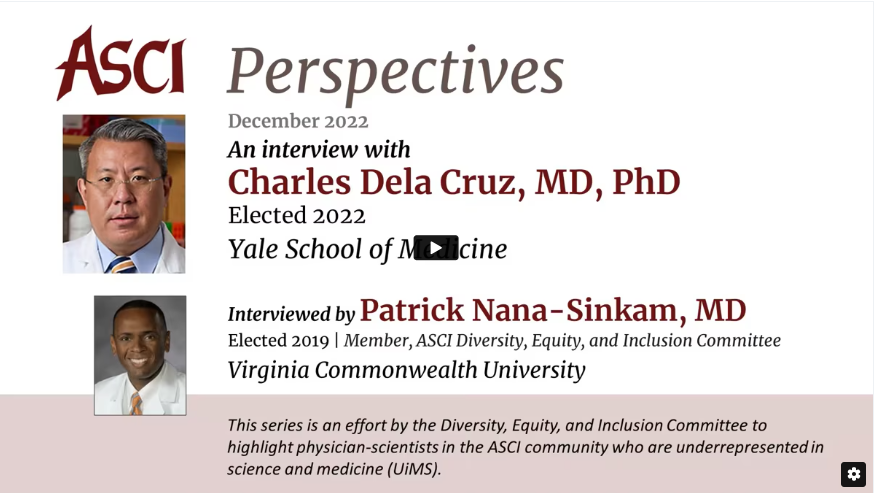
PSEC member Dr. Patrick Nana-Sinkam interviewed 2022 ASCI inductee Charles S. Dela Cruz, MD, PhD (view profile), at the end of the year. Dr. Dela Cruz is Associate Professor of Medicine (Pulmonary Critical Care and Sleep Medicine) and Microbial Pathogenesis; Director, Center for Pulmonary Infection Research and Treatment (CPIRT); Vice Chief, Clinical and Basic Research; and Director, Physician Scientist Training Program in the Department of Internal Medicine at Yale School of Medicine. His laboratory studies the role of respiratory infection in the pathogenesis of acute and chronic lung diseases, specifically how lung infection/pneumonia contribute to inflammation, injury, and tissue repair in the lung. Dr. Dela Cruz discusses his history as a researcher and clinician, offers advice about finding a niche in both areas, and reflects on how the experience with COVID is influencing how the physician-scientist works. — Posted December 2022
John Hawley
Nominations open for the 2023 Seldin~Smith Award for Pioneering Research
The ASCI is pleased to call for nominations for the 2023 Seldin~Smith Award for Pioneering Research. The annual award, accompanied by an unrestricted $30,000 grant to advance academic efforts, honors an early-career physician-scientist who has demonstrated exceptional creativity and accomplishments in biomedical research (see past recipients).
The deadline for receipt of nominations is December 5, 2022, at 11:59 pm Eastern (extended from November 21).
The nominee:
- Must be an MD (or the equivalent);
- Must be more than 2 years but not more than 6 years from first faculty (or the equivalent) appointment as of April 2023;
- Spends substantial time in research while providing direct patient care.
A nomination must be started by the nominator, who then notifies the nominee to complete her/his part of the nomination. The nominee identifies the supporter of the nomination and notifies that person through the submission site to complete her/his support form.
Nominations will be screened to ensure they are complete and fit the nomination criteria. The Seldin~Smith Award Selection Committee reviews nominations and provides recommendations to the Seldin~Smith Award Advisory Committee to determine the recipient.
The nominator must be an ASCI member in good standing and must start the nomination:
- Access your member account
- Go to the “Nominations” tab, then to the “ASCI / Seldin~Smith Award for Pioneering Research” section
- Select “I’m the nominator” option
- Search for your nominee:
- If found, click on “Create nomination”
- If no result is found, provide and save the requested information (first name, last name, and email address), then click on “Create nomination” for the newly created nominee in the “Results” section
- At the top of the nomination form, click on “Send access notification to the nominee at: <email>”
- Provide a 500-word limit statement on the nominee’s most significant achievement
- Submit the statement, which can be done regardless of whether the nominee’s part of the nomination is completed
The nominee receives an email with information to access her/his part of the nomination and then must:
- Provide a birth date and address information
- Provide a summary (100-word limit) of her/his research, followed by a notation of the percentage of time devoted to direct patient care
- Provide detail of:
- Degrees obtained
- Year of first faculty or equivalent appointment
- Current institutional affiliation
- Upload:
- Current NIH-style biosketch
- Three significant publications, each with an annotation (100-word limit)
- Identify the nomination’s supporter and sends notification to the supporter to access her/his support form
- Complete a demographic profile
- Submit this aspect of the nomination, which can be done regardless of whether the nominator or supporter has completed her/his statement
The supporter:
- Does not need to be an ASCI member
- Must be identified and notified by the nominee
- Provides a statement (500-word limit) of the nominee’s research contributions (the statement should be distinct from that of the nominator)
Nominations open for the 2023 ASCI / Stanley J. Korsmeyer Award
Nominations for the ASCI’s 2023 ASCI / Stanley J. Korsmeyer Award are now open. This prestigious recognition, first called the ASCI Award, was renamed in 2006 in honor of Dr. Korsmeyer, the first recipient of the Award in 1998, who passed away in 2005. The Award recognizes individuals for their advancement of knowledge in a specific field and for mentoring future generations of life science researchers. Information on all past honorees is available here.
Current Active and International ASCI members are eligible for nomination. Prior nominees may be re-nominated. However, current ASCI Council members and prior Award recipients may not be nominated.
The deadline for receipt of nominations is October 17, 2022, at 11:59 pm Eastern. Nominations will be screened to ensure they are complete and fit the nomination criteria. The Council reviews nominations, with the outcome of review expected toward the end of November 2022.
Nominators:
- may be any ASCI member in good standing, including members of the Council, and
- must provide a statement (250-word limit) regarding the nominee.
Nominees:
- must currently be an Active or International member;
- must provide a biosketch, full curriculum vitae, and a trainee table; and
- must complete the ASCI’s demographic survey.
To start a nomination:
Nominations may be started by the nominator or the nominee:
- Access your member account
- Go to the “Nominations” tab
- Go to the section for “ASCI / Stanley J. Korsmeyer Award”
For the nominator:
- Select “I’m the nominator” option
- Search for your nominee
- Click on “Create nomination”
- If the nominee has not already claimed her/his part of the nomination, click on “Send nominee information to access the nominee’s part of the nomination” to send the nominee an email to access and edit her/his aspect of the nomination (see above).
- Supply the required information (see above)
- Submit this aspect of the nomination
For the nominee:
- Select “I’m the nominee” option
- Supply the required information (see above)
- Submit this aspect of the nomination
Nominations open for 2023 Honorary membership
The ASCI is pleased to call for nominations for 2023 Honorary membership. Nominees for this recognition must fit the criteria as given in the ASCI bylaws:
Any distinguished person who has contributed significantly to the Society’s objectives, who has not been previously and unsuccessfully nominated for Active or International membership, and who enjoys an unimpeachable moral standing is eligible for nomination in this category.
For the nominee who meets these criteria, there is no restriction on age or degree held.
The deadline for receipt of nominations is October 17, 2022, at 11:59 pm Eastern. Nominations will be screened to ensure they are complete and fit the nomination criteria. The Council reviews nominations and submits its recommendations to Active and Senior members for approval.
Nominators:
- may be any ASCI member in good standing, including members of the Council, and
- must provide a statement (250-word limit) regarding the nominee.
Nominees:
- must provide a full curriculum vitae and
- must complete the ASCI’s demographic survey.
To start a nomination:
The nominator must initiate the process:
- Access your member account
- Go to the “Nominations” tab
- In the section for “Honorary membership”:
- Select “I’m the nominator” option
- Search for your nominee:
- If found, click on “Create nomination”.
- If no result is found, enter the requested information (first name, last name, and email address), save, and then click on “Create nomination”.
- At the top of the nomination form, click on “Send nominee information to access the nominee’s part of the nomination” to send the nominee an email to access and edit her/his aspect of the nomination (see above).
Nominations open for new mid-career member awards, 2023
The ASCI is pleased to call for nominations for two new awards recognizing the scholarly achievements of mid-career members:
The Marian W. Ropes, MD, Award recognizes a middle-career woman physician-scientist. The annual award honors Dr. Ropes (1903–1994), a pioneer both as a researcher on the role of synovial fluid in joint diseases and as a woman in academic medicine. She was the first woman documented to have been elected to the ASCI. The first recipient of this award receives a $10,000 honorarium, will be recognized at the ASCI’s 2023 annual meeting, and gives the Ropes Lecture at the 2024 meeting.
The Louis W. Sullivan, MD, Award recognizes a middle-career physician-scientist who is underrepresented in medicine and science. The award honors Dr. Sullivan (born 1933), a hematologist, health care advocate, and policy leader — having served as US Secretary of Health and Human Services — and who was the first Black physician-scientist elected to the ASCI. The first recipient of this award receives a $10,000 honorarium, will be recognized at the ASCI’s 2023 annual meeting, and gives the Sullivan Lecture at the 2024 meeting.
ASCI members who are within 5 years of their election year may be nominated. Additionally:
- For the Ropes Award, only female members are eligible for nomination
- For the Sullivan Award, only UiMS members are eligible for nomination
The deadline for receipt of nominations is September 28, 2022, at 11:59 pm Eastern. Nominations will be screened to ensure they are complete and fit the award criteria. The ASCI’s Diversity, Equity, and Inclusion Committee will review nominations and submit its recommendations to the ASCI Council for approval. We expect to notify nominees about the outcome by mid-November.
Nominators:
- may be any ASCI member, except for current members of the ASCI Council and the ASCI Diversity, Equity, and Inclusion Committee, and
- must provide a statement regarding the nominee (500-word limit).
Nominees:
- must fit the criteria noted above and may not be current members of the ASCI Council and the ASCI Diversity, Equity, and Inclusion Committee;
- may be nominated only for one ASCI award (for example, a nominee for the Ropes Award may not be nominated for the Sullivan Award, Korsmeyer Award, or Harrington Prize);
- must provide the following:
- a personal statement (750-word limit);
- a full curriculum vitae;
- 3 most-significant publications, each with a 50-word annotation, followed by the member’s role in the publication, the journal name and publication year, and the Pubmed ID noted as “PMID:12345”;
- and must complete the ASCI’s demographic survey.
To start a nomination:
- Access your member account
- Go to the “Nominations” tab
- In the section for the award of interest:
- If you are the nominee, select the “I’m the nominee” option to start your part of the nomination (only you have access to this information); note that this option will not be available for the Ropes Award for male members.
- If you are the nominator, select “I’m the nominator” option, then search for your nominee. Only nominees who are within 5 years of their election year will appear in the results. Note: for the Ropes Award, you will only be able to select a nominee who is a woman; for the Sullivan Award, you may select anyone who is within 5 years of election, but nominations will be screened (based on the information the nominee provides in the demographics survey) to ensure that nominees fit the UiMS criterion.
Voters approve bylaws amendments regarding membership nominations and other items
A ballot was issued to Active voters on July 18, 2022, that proposed the following changes to the organization’s bylaws:
- Temporary increase in Active and International membership nomination age limit. In Article III, Section 2a. Active and International, the proposed amendment was from “A nominee in this section must be a physician who is 50 years of age or less on January 1 of the election year, and who …” to “A nominee in this section must be a physician who is 50 years of age or less on January 1 of the election year, or who is 53 years of age or less for the 2023 and 2024 election years reporting extenuating circumstances, and who …”
- Committee participation. In Article VII – Committees, Section 1, the proposed amendment was from “Committee members may be active or senior members in good standing.” to “Voting committee members must be members in good standing. A committee may have participants in non-voting roles, provided each is approved by a simple majority of voting members.”
- Modify committee name and structure. In Article VII – Committees, Section 7, the proposed amendment was to revise a committee’s name and codify the position of Vice Chair. The Vice Chair would serve a one-year term and succeed to Chair, whose term would be revised from three years to two years. Section 7 would be revised to: “Diversity, Equity, and Inclusion Committee. This committee ensures that the organization, its programs, and its mentoring mechanisms promote and recognize diversity, inclusion, and equity. A Chair serves a two-year term, after succeeding from a one-year term as Vice Chair. In the last year of a Chair’s term, the President nominates a candidate for Vice Chair, who is elected by a simple majority vote of the committee. The President, Vice President, and President Elect are standing members of the committee. Other committee members may be drawn from across the membership and are added by simple majority vote of the committee; these members serve up to 3-year terms that conclude at the start of the Society’s annual meeting or May 1, whichever is earlier.”
By the July 22, 2022, deadline, 42.4% of eligible voters responded, reaching the minimum 40% participation rate required for ballot items regarding bylaws amendments. For each proposed amendment, the percentage of voters who responded favorably was over the 75% threshold required to approve amendments.
Following the bylaw’s Ballot Review Committee section, these results were received, reviewed, and verified by Priscilla Hsue (2021-2023 ASCI Secretary-Treasurer) and two Active members identified by random selection from ballots submitted and who agreed to audit the results. Thank you to Rebecca J. Brown, MD, MHSc (NIH, National Institute of Diabetes and Digestive and Kidney Diseases) and Sudarshan Rajagopal, MD, PhD (Duke University School of Medicine) for their service.
Nominations for Active and International membership, 2023
Nominations for Active and International membership for 2023 are open and may be submitted through September 30, 2022, 11:59 pm Eastern. All participants in a nomination should carefully review the information below. Send questions to staff@the-asci.org.
For the 2023 cycle, the bylaws have been amended to allow nominations of otherwise qualified individuals who are age 53 or younger on January 1, 2023, and whose work has been affected by extenuating circumstances. (This amendment also applies for the 2024 cycle, after which the age limit returns to 50.)
Nominees in these categories:
- must be physicians who have “accomplished meritorious original, creative, and independent investigations in the clinical or allied sciences of medicine” and who enjoy “unimpeachable moral standing in the medical profession” (as stated in the ASCI bylaws);
- must be age 53 or younger on January 1, 2023:
- for candidates age 50 or younger on January 1, 2023, no information is required regarding an extenuating circumstance that may have affected their work;
- for those age 51-53 on January 1, 2023, they need not have been previously nominated, and they must provide information regarding extenuating circumstances that have affected their work; and
- may not be nominated more than three times (including those age 51-53 on January 1, 2023).
Proposers are discouraged from nominating those whose qualifications may not be sufficiently advanced, or from re-nominating a candidate if the candidate’s work has changed little since their previous nominations.
The ASCI Council reviews nominations and may recommend up to 100 Active and International nominees for election. The Council presents the recommended nominee group to Active and Senior members to approve by vote. Those elected for 2023 will be recognized at the ASCI’s annual Dinner and New Member Induction Ceremony, April 21, 2023, as part of the 2023 AAP/ASCI/APSA Joint Meeting, April 21-23, 2023, at the Swissôtel Chicago.
Note that Council members may not serve in any capacity regarding nominations.
Nomination preparation guidance and instructions
A nomination requires one Proposer and one Seconder, both of whom must be ASCI members in good standing and (if applicable) current in Society dues. General Supporters are optional.
There is no limit to the number of nominations a member can propose or support (either as Seconder or General Supporter).
The Proposer is ideally from an institution different from the nominee’s institution (although this is not required) and should have a good understanding of the nominee’s work. The Proposer is responsible for:
- starting the nomination (see “ASCI account access” below);
- granting access to the nominee to edit certain sections of the nomination (see detail in “Nomination sections” below); please note that granting access is optional but strongly encouraged to help ensure accuracy of information and to reduce the time burden on Proposers;
- providing the “Proposer’s general statement on the nominee” (500-word limit) and “Statement on progress and development since previous nomination” (if applicable, 500-word limit);
- ensuring that the nomination is accurate and complete; and
- submitting the nomination.
Nominees may, if granted access, edit certain sections of the nomination.
The Seconder is ideally from an institution different from the nominee’s institution (although this is not required) and should have a good understanding of the nominee’s work. The Seconder is responsible for completing and submitting a form that includes:
- scores for the areas enumerated in the form;
- comments (500-word limit) that supplement, but do not duplicate, information provided by the Proposer and deal specifically with the nominee’s original scientific contributions; and
- description of the relationship to the nominee.
General Supporters (not required; limited to 3 per nomination) may help to provide additional context for a nominee’s contributions, and to demonstrate wider support for the nominee beyond the candidate’s own institution, particularly if the Proposer and Seconder of a nomination are from the nominee’s institution. Anyone (including any ASCI member) may serve as a General Supporter. The General Supporter completes and submits a form that includes:
- scores for the areas enumerated in the form;
- comments (250-word limit) that supplement, but do not duplicate, information provided by the Proposer or the Seconder and deal specifically with the nominee’s original scientific contributions; and
- description of the relationship to the nominee.
A nomination support template may be referenced in order to aid in drafting comments. Please note, however:
- General Supporters who are ASCI members should complete and submit the required information online through their member accounts (see “ASCI account access”).
- General Supporters who are not ASCI members should request that the Proposer add them to the nomination, where the Proposer can send emails to such supporters that include information about accessing their specific form.
ASCI account access
- Access your account
- Go to the “Nominations” tab, navigate to the “Active and International membership” section, and click on “Search for a nominee”
- Enter the nominee’s last name (you may enter a partial name)
- If a result is found, select your role (Proposer, Seconder, or General Supporter)
- If no result is found, provide the requested information to start the nomination
Nomination sections
- About the nominee — nominee may edit this information.
- Nominee’s demographic information — nominee may edit this information.
The ASCI requests responses to questions in a brief, 9-section survey that will help provide the foundation for expanding diversity, fostering inclusion, and achieving equity in the ASCI. All response areas are voluntary, with a “Prefer not to answer” option available for each section. Anyone with access to person-specific information (such as ASCI leadership, members associated with review processes, and staff members) will be required to keep the information confidential. Depersonalized summary information of all response areas may be provided in periodic public reports. - Support for nomination — Only accessible to the Proposer.
Proposers may attach a Seconder and General Supporters to the nomination by searching the ASCI member directory; for a supporter who is not an ASCI member, Proposers must supply the supporter’s name and email address in order to attach the person to the nomination. After supporters are attached to the nomination, Proposers are provided the ability to notify them regarding their support forms. - Nominee’s institutional affiliation — nominee may edit this information
- Documents — nominee may edit this information:
- Full academic curriculum vitae, including:
- current funding (clearly indicate whether the nominee is a principal investigator),
- past funding,
- invited lectures,
- patents, and
- full bibliography (with original research separated from other types of publications and the nominee’s name presented in bold face).
- NIH-style biographic sketch (5-page limit), following the current format available at:
http://grants.nih.gov/grants/forms/biosketch.htm - A high-resolution headshot photograph (for use if the nominee is recommended for election)
- Three “Most significant publications,” excluding those representing work done by the nominee as a trainee. For each of these three files, an annotation is required and consists of two aspects:
- List authors in the original publication sequence, with the nominee’s name in capital letters, followed by numbered notation of the nominee’s role in parentheses (1 = principal investigator, 2 = collaborator), title, journal name, volume, inclusive page numbers, year, and Pubmed ID (PMID). Example:
“John Q. Public and JANE DOE (1). Title. Journal. 1:1-10 (2015). PMID 1234” - A description (50-word limit) of the publication’s key findings and significance.
- List authors in the original publication sequence, with the nominee’s name in capital letters, followed by numbered notation of the nominee’s role in parentheses (1 = principal investigator, 2 = collaborator), title, journal name, volume, inclusive page numbers, year, and Pubmed ID (PMID). Example:
- Full academic curriculum vitae, including:
- Extenuating circumstances — nominee may edit this information.
A nominee who is age 51-53 as of January 1, 2023, must select at least one of the extenuating circumstances provided: “elder care/other types of caregiving”; “child care”; “illness”; or “other”. An explanation of the circumstance(s) may be provided and is encouraged, but the explanation is optional. - Seminal contribution(s) — nominee may edit this information.
Summarize the nominee’s defining seminal contribution(s) and why this work forms the basis for the nomination. 75-word limit. - Proposer’s general statement on the nominee — only accessible to the Proposer.
In the Proposer’s own words (500-word limit), describe the quality, originality, and impact of the nominee’s scientific work and the consistency and importance of the nominee’s research theme. Include a statement on the level of independence from the nominee’s mentor(s) and the nominee’s productivity and stature in the field.- Proposers should expand upon the candidate’s seminal contribution(s), including the originality, novelty, and impact of this research on the field. Note any special circumstances (e.g., childbearing, personal or family illness) that influenced the candidate’s research activities.
- Information regarding major awards, invitations to give plenary lectures (especially at national and international meetings), and invitations to write chapters in major textbooks should be included as applicable — the quality and quantity of work are important factors.
- Statement on progress and development since previous nomination — only accessible to the Proposer.
In the Proposer’s own words (500-word limit), describe the critical differences between this nomination and the previous nomination (if applicable).
Valerie A. Arboleda, MD, PhD—full video
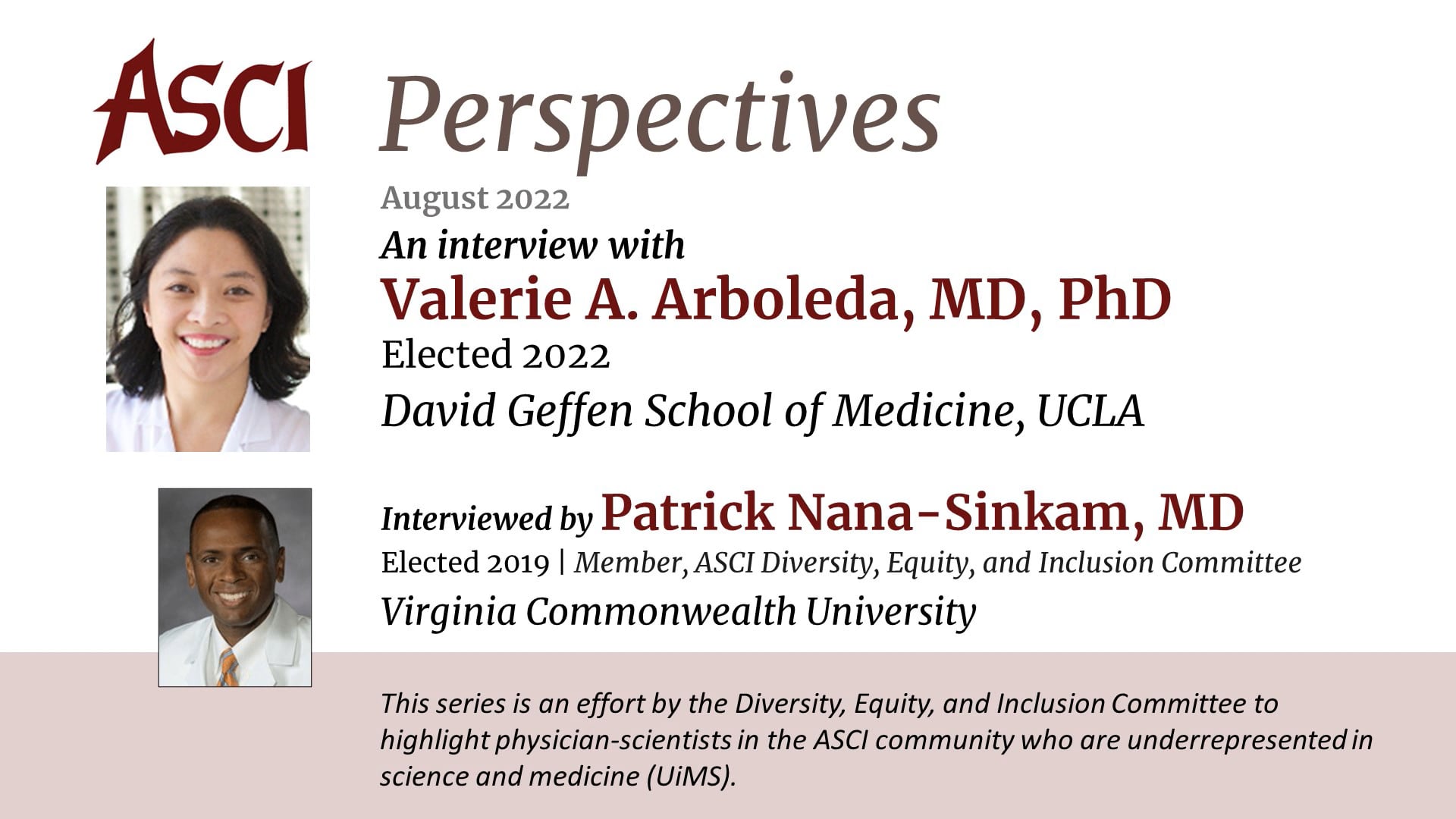
Our second Perspectives video features PSEC member Dr. Patrick Nana-Sinkam’s interview with 2022 ASCI inductee Valerie A. Arboleda, MD, PhD (view profile), Assistant Professor of Pathology, Laboratory Medicine, and Human Genetics at the University of California, Los Angeles. Dr. Arboleda’s research focuses on the application of next-generation sequencing to understand the basis of genetic syndromes. She talks about her scientific background; her contribution to developing an FDA-approved scalable COVID-19 test; and the need to improve equity in genetic testing.
From the JCI Editor: New Impact Factor and launch of Research Letters

On behalf of the Journal of Clinical Investigation’s Editorial Board, I am humbled by the opportunity to serve the ASCI and to have the privilege of determining the cutting-edge biomedical research published by the Journal. I am delighted to share with you that the JCI’s latest Journal Impact Factor (IF) is 19.456, representing a 24% increase from the previous year. Our sister journal, JCI Insight, has also increased its IF, which now stands at 9.484. This strong performance highlights the strength of our authors’ articles and reflects the importance of our mission to understand the basis of human disease. We are grateful to our authors for entrusting us with their work, to our reviewers and consulting editors for their dedication to maintaining the highest standards, and to the prior editorial team at Johns Hopkins for their expert leadership during the unprecedented challenges of the pandemic. These successes affirm the ASCI’s voice and the critical role of societies in the publishing landscape.
As stewards of the JCI, the Northwestern-based Editorial Board is dedicated to continuing and improving the Journal’s record of excellence. We encourage submission of Research manuscripts that define disease processes. We welcome work that utilizes human data, from “n of one” to “big data” studies, while remaining interested in translationally relevant animal models and preclinical investigation. We also encourage Clinical Medicine submissions focused on human studies that have the potential to impact clinical practice or inform understanding of diseases.
Recognizing the need to disseminate certain high-impact findings quickly, we have launched a new submission category, Research Letters — focused reports of an original preclinical or clinical research finding of exceptional interest to the JCI readership presented in a single-figure (or -table) format.
As a reminder, ASCI dues-paying members who are the corresponding author of a first-round submission to the JCI, and whose dues are current, may designate one submission per calendar year to be guaranteed for external peer review. We encourage you to take advantage of this benefit by sending us your best work that advances the understanding of pathogenesis.
I wish you all the best and thank you for your support of the JCI.
Sincerely,
Elizabeth M. McNally, MD, PhD
Editor, The Journal of Clinical Investigation
Officer, ASCI Council
Consuelo H. Wilkins, MD, MSCI – full video (July 2022)
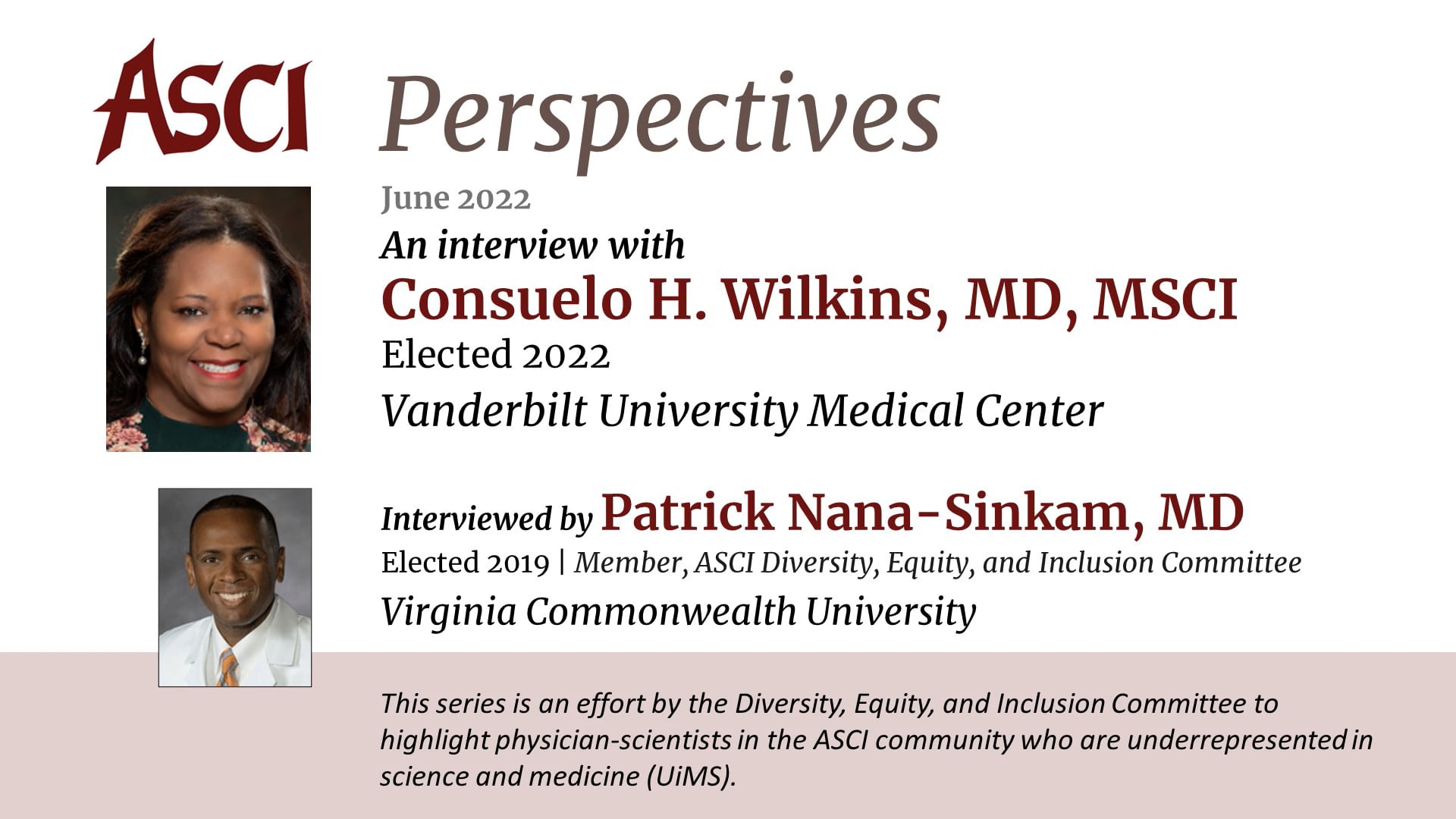
The PSEC is proud to initiate the ASCI Perspectives series with DEIC member Dr. Patrick Nana-Sinkam’s (elected 2019; view profile) interview with Consuelo H. Wilkins, MD, MSCI (elected 2022; view profile). Dr. Wilkins is Chief Equity Officer and Senior Associate Dean for Health Equity and Inclusive Excellence; Associate Director of the Vanderbilt Institute for Translational Science; and Professor of Medicine, Division of Geriatric Medicine, Vanderbilt University. She was elected to the National Academy of Medicine in 2020. In the interview, Dr. Wilkins, a leading health equity researcher, discusses the origins of her research path and shares lessons learned.