
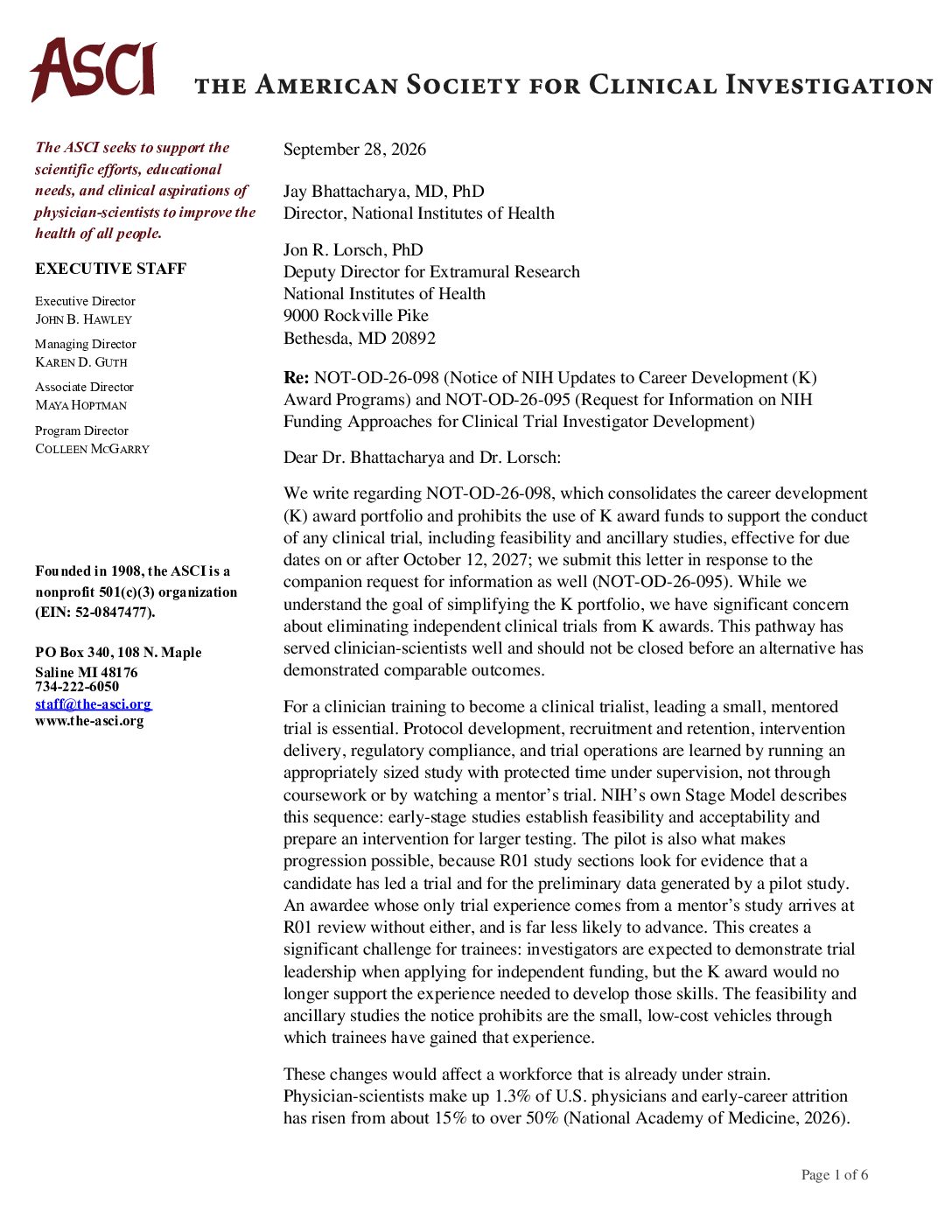
Open letter to the NIH regarding proposed changes to K awards

The ASCI has issued an open letter to the National Institutes of Health leadership regarding its recent proposed changes to K awards. The letter is co-signed by 30 professional organizations and foundations.

The letter responds to the proposed changes detailed in NIH’s “Notice of NIH Updates to Career Development (K) Award Programs” (NOT-OD-26-098) and “Request for Information (RFI): Input on Potential NIH Funding Approaches to Support the Development of Future Clinical Trial Investigators” (NOT-OD-26-095).

Read the letter

A clinician learns to run a trial by running one: a small, mentored study carried out on protected time during the K award. The study sections that review R01 applications, NIH’s main grants for independent research, expect evidence that a candidate has led a trial, along with the pilot data it produced. In NIH RePORTER records on 6,588 K01, K08, and K23 awardees from FY2010 to FY2020, those whose K included a trial did just as well as other K awardees in winning later NIH and R01 funding, and were nearly 2.5 times as likely to go on to lead their own NIH-funded trial. Two-thirds of these K trials are pilots, with a median enrollment around 60. If K funds can no longer pay for such studies, there is no ready source of alternate funds: industry has no product to sell in an implementation trial and foundation money is scarce. Trial training and the careers it launches would concentrate at a small set of well-funded institutions.

The letter asks NIH to do three things.

  1. Tier the clinical trial definition to differentiate feasibility, implementation, and ancillary studies from definitive trials.
  2. Keep the trial-permitted K01, K08, and K23 awards open and funded for at least five more years, while NIH works through the challenges of the new model, so the transition does not drive further attrition of physician-scientists.
  3. Shape the approaches described in the RFI so awardees have enough time to do the pre-trial work, apply for the RPG, and finish the trial in time to compete for independent funding.

NIH has spent decades investing in its scientific workforce, and the ability to design and lead clinical trials deserves the same sustained investment and stewardship. Trial leaders are the ones who bring NIH’s discoveries into patient care. The current pathway has supported them at 340 institutions in all 50 states and Puerto Rico; the ASCI and its co-signing societies stand ready to work with NIH on the design of these mechanisms.

The letter is the product of an ASCI working group chaired by Lilia Cervantes, MD, MSCS (University of Colorado School of Medicine) with the following members: Nisha Bansal, MD, MAS (University of Washington School of Medicine); Jeremy M. Berg, PhD (University of Pittsburgh School of Medicine); Charles S. Dela Cruz, MD, PhD (University of Pittsburgh School of Medicine); Holger K. Eltzschig, MD, PhD (University of Texas Medical School at Houston); Alessia Fornoni, MD, PhD (University of Miami Miller School of Medicine); Orlando M. Gutierrez, MD, MMSc (University of Alabama at Birmingham School of Medicine); Rajan Jain, MD (University of Pennsylvania Perelman School of Medicine); Suneil K. Koliwad, MD, PhD (University of California, San Francisco, School of Medicine); Jennifer W. Mack, MD, MPH (Harvard Medical School, Dana-Farber Cancer Institute); Ken Nakamura, MD, PhD (Gladstone Institutes); Kyu Y. Rhee, MD, PhD (Weill Cornell Medicine); and Ronald Sokol, MD (University of Colorado School of Medicine).

Nominations open for the 2027-2028 ASCI PSSF Fellowship Application Cycle

The ASCI is pleased to call for nominations for the 2027–2028 ASCI PSSF Fellowship. The fellowship program provides MD-only medical students with a 12-month immersive and mentored gap-year training experience in basic, translational, or applied biomedical research.

The fellowship includes a $42,000 stipend and an additional allowance of $8,000 for health insurance and travel expenses.

Nominators are encourage to initiate their nominations by October 30, 2026 (deadline extended).

The application’s final deadline is January 5, 2027, at 11:59 pm Eastern.

Instructions to nominate:

  • Nominees must be identified by their medical school dean or an ASCI member research mentor.
  • Institutions may nominate more than one candidate, but only (1) one finalist will be selected per institution.
  • Medical school deans submit the nominee’s name and email address to programs@the-asci.org. The nominee’s research mentor submits nomination materials via a secure portal.
  • ASCI member research mentors submit their nomination through their ASCI member portal.
  • Nominees may identify one other supporter, this individual does not have to be an ASCI member.

Research mentors provide:

  • Brief statement of support (250 words) with a description of the nominee’s strengths and suitability for this program, and a
  • CV, bio sketch, and training table (PDF).

Nominees provide:

  • Contact information and headshot (to be published only if accepted, the headshot is not used as part of the review),
  • Brief biographical statement (250 words),
  • Comprehensive research proposal (1,000 words without references),
  • Curriculum vitae and undergraduate and medical school transcripts (unofficial are acceptable).

Typical Applicants are:

  • motivated by scientific curiosity
  • responsible for selecting a research mentor with an active research program, sustained external grant support, a strong record of training students, and the time and interest to mentor the applicant.

Candidates will propose research projects and, if selected, will commence the project under the close guidance of their respective mentor(s). Fellowships will be awarded based on the applicant’s potential to maintain their research trajectory and become a physician-scientist. 

The ASCI PSSF Fellowship includes:

  • a $42,000 stipend and an additional allowance of $8,000 for health insurance and travel expenses.
  • access to a monthly seminar series with ASCI PSSF Advisory Committee mentors and special guest speakers.
  • a mid-year celebration to present fellowship research findings.
  • complimentary registration to the AAP/ASCI/APSA Joint Meeting and programmatic access, including invitations to the:
    • Early Career Award Welcome Reception,
    • ASCI Dinner and New Member Induction Ceremony,
    • Food & Science Evening, and
    • Small Group Dinner with the ASCI PSSF Advisory Committee.
  • Access to ASCI’s virtual community programming, including our:
    • ASCI Scientific Sessions – a virtual spotlight, held every two months, on distinguished investigators and their contributions to the field of biomedical research,
    • peer review groups and near-peer mentoring opportunities, and
    • activities on various biomedical topics led by established physician-scientists.

Eligibility:

  • The ASCI PSSF Fellowship is open to United States citizens and US permanent residents only.
  • Prior laboratory research experience is not required.
  • Candidates may apply during any year of their medical school studies; applicants in the last year of school must defer graduation until the completion of the fellowship year.
  • They may not be enrolled in a combined MD/PhD program, a PhD program, a PharmD, an ScD program, or have completed a PhD, PharmD, or an ScD in a laboratory-based science.

Fellowship candidacy will be evaluated based on the feasibility and scientific rigor of the proposed research projects, as well as the candidate’s strength of commitment and potential to successfully advance as a physician-scientist. The quality of the proposed training experience is determined through evaluation of the research plan and the mentor’s endorsement, which should specify their research qualifications (e.g., expertise and publication record in the research area) and external grant support to fund the research project for the entire fellowship term.

Important dates:

  • Online Application Date: August 31, 2026
  • Dean or ASCI Member Nomination Deadline: October 30, 2026
  • Application Deadline: January 5, 2027
  • Finalist Interview Period: February 22 – February 26, 2027
  • Award Notification Date: Early-March, 2027
  • Award Acceptance Deadline: March 16, 2027

Contact

For information or questions, contact us at programs@the-asci.org.

Nominations are open for the 2027-2029 ASCI Postbaccalaureate Scholars Program

The ASCI is pleased to call for applications for the 2027-2029 ASCI Postbaccalaureate Program, a mentored research experience in an ASCI-member laboratory. By the end of the two-year term, postbacs will possess the experience, confidence, and research acumen necessary to become competitive MD or MD-PhD candidates entering the physician-science pipeline.

Postbacs will attend and present their research at the 2028 and 2029 AAP/ASCI/APSA Joint Meetings and are expected to co-author papers describing their research projects.

Nominations for this cycle are open now through January 31, 2027.

This program provides an intensive, two-year mentored laboratory research experience for students that will expose them to the physician-scientist career path, strengthen their applications to MD or MD-PhD programs, and enhance their career development. From the nominations, two finalists will be selected.

Nominees are undergraduates who are either in their last year of study or are college graduates who have received their bachelor’s degree within two years at the time of submission. Nominees should intend to apply to medical school during their second year of the Postbac Program.

Nominations consist of the following:

Nominators are ASCI members in good standing who are able to provide a suitable environment for their nominees and who, by way of their nomination, are indicating their agreement to host the nominee if selected for this recognition. (This is different from previous cycles in which nominees would be matched with member labs via a separate solicitation for members interested in hosting a postbac.)

  • The nominator provides:
    • a 250-word statement focused on a description of the nominee’s strengths and suitability for this program, and
    • a trainee table (PDF)
  • The nominee provides:
    • a 750-word essay that describes the nominee’s research experience, current interests and career goals;
    • an undergraduate transcript (PDF);
    • a curriculum vitae (PDF);
    • headshot photograph (JPG etc.) (this file is not used in the review process);
    • one letter of recommendation (see more below); and
    • a completed ASCI demographics survey.

Frequently Asked Questions

See the main ASCI Postbaccalaureate Program page.

Contact:

For information or questions, contact us at programs@the-asci.org.